
Sentinel Field Note #2
How to Pick a Personalized Military Gift That Actually Feels Personal
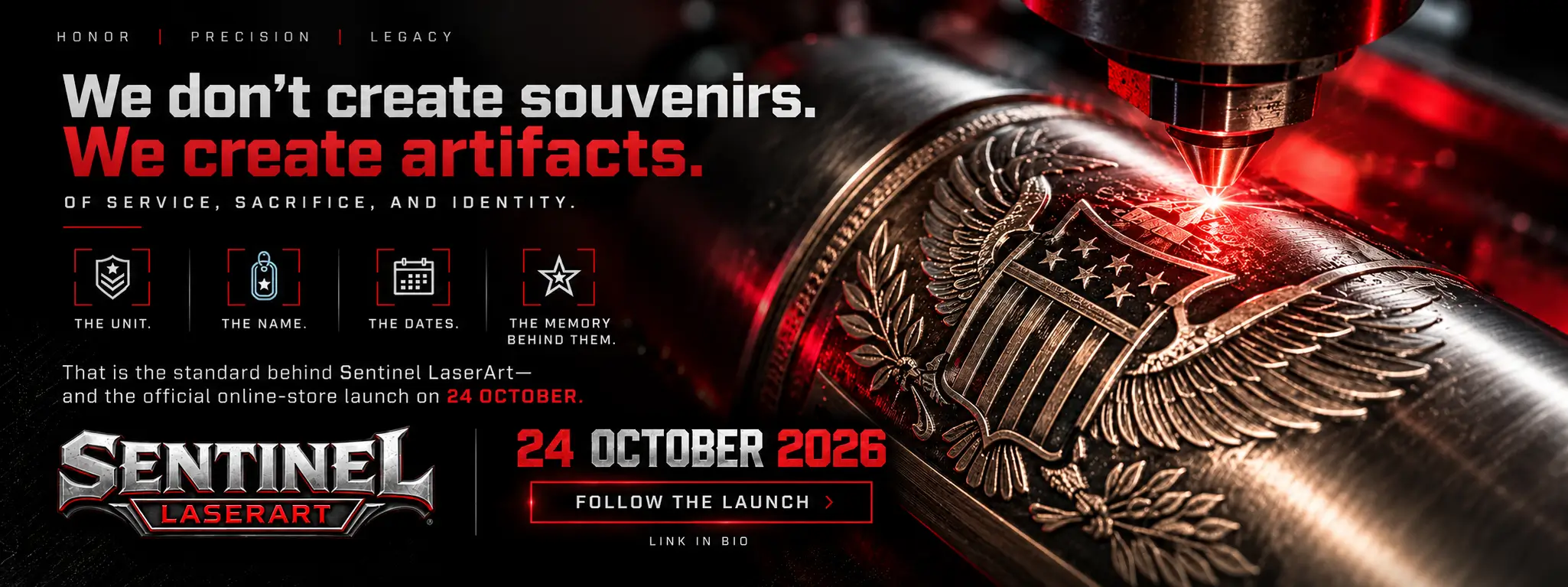
The best personalized military gift is not the one with the most engraving. It is the one that identifies the right person, service connection, and moment with enough precision to feel unmistakably theirs.
If you are choosing a gift for a retirement, promotion, permanent change of station, reunion, graduation, recognition, or personal milestone, begin with the story—not the product. Once you know what the gift should recognize, the object and personalization become easier to choose.
This guide explains how to choose a personalized military gift without relying on guesswork, generic imagery, or a crowded list of details.
1. Identify the Moment Being Recognized
Start with the occasion. A retirement gift carries a different message than a promotion gift. A reunion piece may emphasize shared identity. A PCS farewell may focus on a team, assignment, or location. A graduation gift often marks entry into a new professional community.
Write the occasion in one sentence:
This gift recognizes ________.
If the sentence is vague, the design will probably be vague. If it is clear—“twenty years of service,” “promotion to a new rank,” “our time in this unit,” or “completion of this course”—you have a useful decision filter.
Every detail added later should support that sentence.
2. Define the Recipient's Most Important Service Connection
A service member or veteran may have several legitimate identities: branch, unit, specialty, rank, assignment, deployment, or profession. You do not need to represent all of them.
Ask which connection will matter most when the recipient sees the gift. For one person, branch identity may be central. For another, a particular unit or community may carry far more emotional weight. Someone retiring after a long career may want the full arc of service recognized. Someone leaving a close team may care most about the people and assignment they are leaving.
Choose one primary identity and, if needed, one supporting layer. This keeps the design focused.
3. Gather the Details Before Choosing the Layout
Accuracy is part of the gift. Collect the information before ordering, especially if the piece is meant to mark a formal milestone.
Useful details may include:
- Full name and preferred presentation
- Rank and correct abbreviation
- Branch or service
- Unit or organization designation
- Specialty, role, or callsign when appropriate
- Years or dates being recognized
- Location, deployment, class, or event
- A concise personal inscription
Confirm spelling, punctuation, capitalization, and dates with someone who knows. Do not rely on memory when another person can verify the information. If the gift is a surprise, a colleague, unit member, spouse, or family member may be able to check details discreetly.
4. Choose the Object for the Recipient, Not the Giver
The object should fit the recipient's life and the occasion. Consider where it will be used or displayed. A functional piece may become part of a daily routine. A commemorative piece may belong on a desk, shelf, or wall. A group gift may need enough visual presence to carry multiple names or a formal inscription.
Avoid choosing only by what photographs well or what you personally prefer. Ask:
- Will the recipient use or display it?
- Does the format suit the amount of information?
- Is it appropriate for the occasion?
- Can the design remain readable at the finished size?
- Does it feel consistent with the recipient's style?
The right format gives the story enough room without forcing unnecessary detail.
5. Build a Clear Personalization Hierarchy
Not every detail should have equal visual weight. Decide what the recipient should notice first, second, and third.
A simple hierarchy might be:
- Primary identity: Unit, branch, community, or central emblem
- Recipient: Name and rank
- Milestone: Occasion, years, or date
- Personal note: Short inscription, motto, or message
This sequence is not mandatory, but the principle is important. A design without hierarchy can turn meaningful information into visual noise.
Keep the inscription concise. One honest line often carries more weight than a paragraph. If the message requires several sentences, place the longer note in a card and reserve the object for the details that should endure.
6. Use Symbols Carefully
Military symbols are not interchangeable decoration. If you plan to use a unit emblem, badge, motto, crest, or other distinctive element, confirm that it belongs to the organization or role being recognized. Similar names, predecessor units, reorganizations, and informal traditions can create confusion.
Avoid assuming that an attractive graphic found online is correct, current, authorized for use, or suitable for engraving. When historical or organizational accuracy matters, use authoritative references and ask for clarification if sources conflict.
The same discipline applies to terminology. Use the recipient's actual service language. A correctly written unit designation or rank communicates respect; a near miss can become the first thing the recipient notices.
7. Know When a Standard Product Is Enough
A standard product with focused personalization may be the right choice when the design, format, and available fields already fit the story. If you can accurately represent the recipient with a name, rank, unit, and dates, there may be no need to add complexity.
A custom request may be more appropriate when:
- The piece must represent multiple assignments or organizations
- The layout needs several names or a group roster
- The occasion requires a custom emblem or original artwork
- You need an unusual inscription structure
- The available options do not accurately carry the story
Custom does not mean adding more for its own sake. It means the standard configuration cannot do the job without losing what matters.
8. Review the Final Proof as a Record
Before approval, read every line slowly. Check the proof against your source information rather than against memory. Review:
- Name spelling
- Rank and abbreviations
- Unit designation
- Dates and date format
- Inscription punctuation
- Symbol selection
- Overall readability
Imagine the recipient reading it for the first time. Is the intended identity immediately clear? Is anything distracting, ambiguous, or unnecessary? This last review protects both accuracy and meaning.
Choose Specificity Over Volume
A personalized gift succeeds when the recipient recognizes the thought behind it. The goal is not to fit an entire career onto one object. The goal is to choose the details that make the object theirs.
Start with the moment. Identify the service connection that matters most. Verify the details. Choose a form suited to the recipient. Then use disciplined personalization to carry the story without burying it.
For ready-to-personalize pieces, visit the Sentinel LaserArt online store. If your project needs a layout or story that standard options cannot carry, submit a custom request.
Primary CTA: Shop Sentinel LaserArt
Custom-work CTA: Start a custom project request
FAQ
What information should I put on a personalized military gift?
Begin with the recipient's name and the service connection most relevant to the occasion. Rank, unit, years, date, specialty, callsign, or a short inscription can add meaning when accurate and appropriate.
How much personalization is too much?
Personalization becomes excessive when the hierarchy is unclear, the text becomes difficult to read, or details compete instead of supporting one story. Choose the few elements the recipient will value most.
How can I verify military details for a surprise gift?
Ask a trusted colleague, unit member, spouse, friend, or family member to confirm names, rank, unit designation, dates, and terminology. For official symbols or historical claims, use authoritative military or government references.
Should I choose a standard item or request custom work?
Choose a standard personalized item when its format and options accurately fit the recipient. Request custom work when the story requires an original layout, multiple organizations, several names, custom artwork, or another structure that standard options cannot represent well.
What should I write as an inscription?
Use one concise line tied to the recipient and occasion. A direct expression of gratitude, a phrase meaningful to the group, or a short statement of service often works better than a generic slogan.